
Choosing not to have children is a valid personal decision, even though it often feels anything but simple. You’ve probably experienced this, maybe at a family dinner or during a casual brunch. The question comes up. The pause. That look. And when you say you don’t want children, the room subtly shifts. Someone laughs awkwardly. Someone else reassures you that you’ll “change your mind.” A well-meaning relative tells you that motherhood is what makes life meaningful. Suddenly, a private personal decision becomes a referendum on your character.
Many women struggle not because they doubt themselves, but because society constantly questions their choice. And when a choice is treated that way long enough, it’s easy to internalize the message that something must be wrong with you. It’s not surprising that many women quietly ask themselves: “Am I a bad woman for not wanting kids?” The short answer is No.
Why Society Makes Women Feel Guilty for Not Wanting Kids
From a young age, many women absorb a quiet narrative: You grow up. You fall in love. You have children. This is presented less as an option and more as a life path—like puberty or aging. Movies, family conversations, and even casual comments reinforce the notion that motherhood is the natural culmination of womanhood.
Choosing not to have children doesn’t just disrupt expectations, it challenges the unspoken script. That’s why the reaction can feel so personal. In some places, not wanting kids isn’t treated as a preference, like not wanting to live in the suburbs or not liking a certain career path. Instead, it’s often framed as a deficiency, a rebellion, or a phase. Over time, the pressure can make choosing not to have children feel like a personal failure rather than a neutral life choice.
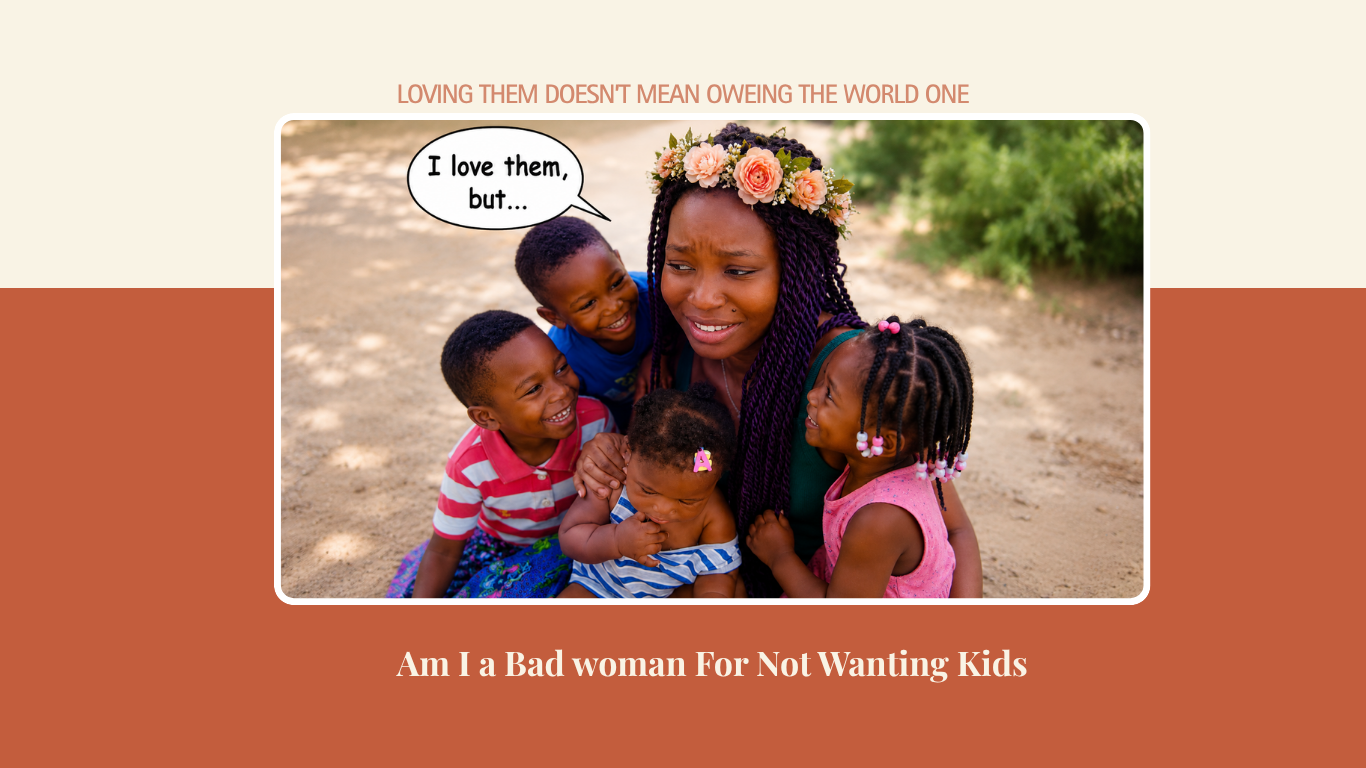
One of the most persistent myths about childfree women is that they dislike children or lack empathy. But here’s the truth: choosing not to have children is not the same as rejecting care or love. In reality, many women without kids are deeply nurturing, emotionally attuned, and invested in relationships. They simply don’t want parenthood. Loving children doesn’t obligate you to raise them. And not wanting kids doesn’t mean you lack warmth, generosity, or purpose.
Common Emotional Reactions

Image: Pinterest
Women who are choosing not to have children often aren’t struggling with the decision itself, but with how that decision is received. The emotional reactions that surface are shaped less by personal uncertainty and more by repeated external pressure.
Guilt
Many women feel responsible for managing other people’s expectations, especially parents or partners. If you feel responsible for the feelings of others, the idea of disappointing loved ones can weigh heavily, even when you’re confident in your choice.
Shame
Cultural messages frequently frame motherhood as a defining feature of womanhood, so not fitting that mold can lead to an internalized belief that something is missing or wrong, even when it isn’t.
Defensiveness
When questions feel intrusive or dismissive, you may find yourself justifying your choice or preparing explanations in advance.
Self-doubt
Tends to surface during moments of comparison or future-focused thinking. Hearing constant warnings about regret or fulfillment can plant questions that wouldn’t exist in a more supportive environment.
Fear of judgment or misunderstanding
Many women worry they’ll be seen as selfish, immature, or incomplete, leading them to withhold honesty or soften their truth to avoid conflict. Sometimes you may find yourself comparing yourself to mothers and wonder if you’re “missing something.” Or you find yourself over-explaining your decision to justify it.
These emotional responses are not signs that the choice is wrong. They are normal reactions to navigating a deeply personal decision in a society that still treats motherhood as the default.
Understanding Personal Choice
At its core, deciding whether to have children is about autonomy. It’s about aligning your life with your values, not someone else’s expectations. You don’t need a tragic backstory to justify not wanting kids. Some women prioritize flexibility, career focus, creativity, or emotional bandwidth. Others consider relationship dynamics, mental health, or the kind of lifestyle they want to maintain.
It’s not selfish; people want different things out of life, and that’s okay. Personal choice and kids are deeply connected to identity, and there is no universal blueprint for a meaningful life.
How Pressure Shows Up in Relationships

Image: Pinterest
Pressure doesn’t always come loudly. Sometimes it’s subtle, like a raised eyebrow, a “you’ll change your mind,” or unsolicited advice. Partners may have expectations they’ve never fully examined. Family members might ask the same questions repeatedly, testing boundaries without realizing it.
These moments can create relational tension, especially when your choice is treated as temporary or negotiable. Over time, this can strain communication and leave you feeling misunderstood or defensive.
How to Communicate Your Choice Confidently
Communicating your choice not to have children confidently starts with clarity. Clear statements like “This is the right decision for me” or “I’m not planning to have kids” set the tone and reduce room for debate. You don’t need to justify your reasoning in detail—simple explanations are often more effective than long ones because they signal certainty rather than defensiveness.
A calm tone helps keep the conversation grounded, even when others push back. Staying neutral and steady communicates that your choice isn’t up for negotiation. If the discussion starts to feel intrusive or repetitive, redirecting the conversation by changing the subject or setting a gentle boundary can help protect your emotional space without escalating tension.
Maintaining self-respect means recognizing that confidence doesn’t come from convincing others. It comes from staying aligned with your values and refusing to argue your worth.
Coping with Guilt and Judgment
Coping with guilt and judgment takes practice, especially when the pressure comes from people you care about. Each of the following approaches helps shift authority back to you and reduces the emotional weight of outside opinions.
Self-validation
Self-validation means acknowledging that your feelings and choices are legitimate without waiting for approval. You don’t need permission to trust yourself. Instead of asking, “Is this acceptable to others?” you begin asking, “Is this right for me?” Regularly reminding yourself why your choice aligns with your values helps counteract internalized doubt.
Setting boundaries
Setting boundaries, both emotional and conversational, helps protect your peace. This can mean limiting how much you discuss your decision, changing the subject, or clearly stating that the topic isn’t open for debate. Boundaries aren’t about being defensive, they’re about preserving your well-being and preventing repeated emotional strain.
Reflective journaling
Journaling allows you to separate your own beliefs from external voices. You can write about moments when you start feeling guilty for not having kids. This helps clarify whether guilt is coming from within or from external pressure. Over time, patterns emerge that strengthen self-understanding and confidence.
Compassionate self-talk
The way you speak to yourself matters. When guilt or shame surfaces, replace harsh inner criticism with kindness, “I’m allowed to choose what fits my life.” Remind yourself that feeling conflicted doesn’t mean you’re wrong. Compassionate self-talk reinforces self-trust and emotional safety.
Seeking support
Talking to people who listen without trying to change your mind makes a real difference. This might include a trusted friend, therapist, or mentor who respects your autonomy. Supportive conversations help normalize your experience and reduce the sense of isolation that judgment can create.
Peer networks
Connecting with others who share similar life choices provides perspective and reassurance. Peer networks, whether in person or online, offer shared language, validation, and examples of fulfilled lives outside traditional expectations. Seeing your experience reflected in others reduces self-doubt and builds confidence.
Finding Community and Support
Connecting with other childfree women or women without kids can be grounding. Friends who share similar life decisions often provide the greatest sense of relief, there’s less explaining, fewer assumptions, and more room to simply be yourself. Online communities can offer that same validation when in-person connections are limited, showing the wide range of ways a woman can build a meaningful life without children.
Mentorship and women-centered networks add another layer of support. These spaces tend to focus on shared interests, growth, and mutual respect rather than traditional milestones, making it easier to feel seen for who you are. Seeing women, especially older women, who are fulfilled and confident in their choices helps counter fear-based narratives about the future.
Signs You’re Embracing Your Choice
Embracing your choice shows up less in big declarations and more in quiet internal shifts. These signs reflect growing self-trust and comfort with your decision.
Inner peace
You feel calmer when thinking about your future. The decision no longer creates constant mental noise or second-guessing. Even when others disagree, there’s a steady sense that you’re on the right path for yourself.
Reduced guilt
Guilt doesn’t disappear overnight, but it softens. You stop feeling responsible for managing other people’s expectations and recognize that disappointment from others doesn’t mean you’ve done something wrong.
Confidence in discussions
When the topic comes up, you’re able to speak plainly without bracing for conflict. Your words feel natural rather than rehearsed, and you don’t feel the need to defend or persuade.
No over-explaining
You notice that you’re offering shorter answers and fewer justifications. This shift reflects certainty.
Feeling aligned with values
Your decision feels connected to how you want to live, not just what you want to avoid. Your daily choices, priorities, and long-term vision make sense together.
Joy in your personal path
You begin to feel genuine excitement and appreciation for the life you’re building. Instead of measuring yourself against others, find satisfaction in your own direction and possibilities, shaped by the diverse global influences of our modern era.
Wrapping up, not wanting kids is a valid personal choice, even when it’s challenged by cultural motherhood expectations. Much of the pressure women feel comes from external messages that become internalized over time, making doubt feel personal when it isn’t. But confidence develops gradually, through clarity about your values, healthy boundaries, and supportive connections.

Staff writer at Women Digest covering beauty, fashion, wellness and life.